Showing posts with label Spanish. Show all posts

Monday, February 29, 2016

where the ink disappears to


Painting turtles with my favorite artista.
 
Sometimes I feel like I am writing in disappearing ink.

I labor late into the night over a 3 page scholarship essay but don’t advance to the next phase of competition. I meet with someone who is struggling and spend hours thinking about how to best help her, but she won’t respond when I try to reach out for follow-up. I pray for the same person every single morning but don’t see a whit of change in their life.

These moments of letdown, of stasis, of seemingly fruitless waiting are torturous for a person who wants to get stuff done (a.k.a ME). When I pour myself into an effort that doesn’t yield results, it feels like I’ve just written pages upon pages, only to realize that I was using disappearing ink and all of it has vanished – all the emotions, all the energy, all the time.

But I cling to a truth very different from what I sometimes feel. I believe that God is working in space and time, weaving every “wasted” minute into a triumphant plot twist that I am simply too short-sighted to anticipate.

Speaking of short-sighted, I am. Literally. Everything more than five feet in front of me melts into a watery blur when I’m not wearing glasses or contacts. My vision is worse than most peoples’, but since I live in an era and a country with excellent optical technology I don’t think much about it. Still, I can’t say I’ve ever given thanks for my limited sight. Not, that is, until a few Saturdays ago.

Two weeks back, I met a boy of around eight years old at the refugee shelter. I’ll call him Orlín. Orlín has been blind since birth; he has no idea what the sun or a house or even his own mother’s face looks like. I couldn’t tell at first because I found him zooming Matchbox dump trucks around the kitchen at just a few notches short of light speed. (Apparently Orlín had already felt around the room and figured out where the obstacles were.) His mom had to tell me that he was blind when he tried to join in a game that involved distinguishing between red and black playing cards.

Partway through the afternoon, I brought out my watercolor paints. Orlín wanted to paint with the other kids. He dipped his fingers into the water dish I gave him to make sure it was full and clutched the red plastic paintbrush with a vice grip. I asked Orlín which colors he wanted, and there was – of course – a long pause.

“Rojo, azul, verde, amarillo, morado…” I began to list off the colors in my box.

“!Todos los colores!” Orlín answered. All of the colors!

Wrapping her hand around his clinched fist, another shelter volunteer showed Orlín where the colors were on his palette. Orlín has no way of understanding what colors are, but he memorized their names and could tell when one of them was running low – “!Necesito más azul!”, he would command, waving his paintbrush at me as if it were a scepter.

Orlín leaned low when he painted, his face just inches from the page. Every so often he looked up at me and asked,

“?Qué pinté yo?”

“El mar,” I would tell him. The ocean.

Como se ve el mar?” What does the ocean look like?


“Your ocean,” I said to Orlín, “Is blue, but it turns green when the sun hits it. The sun is warm and golden, which is why there are threads of gold in your ocean. The sun is mixing with the water. Es bellísima – it’s so beautiful!”

Sometimes I told Orlín that he was painting a forest with green-capped trees, or a red and yellow flower. But he painted with gusto and every picture wound up dripping wet and saturated with color. In the end, Orlín agreed that all of his paintings were oceans. Before I left he asked me,

“?Dónde están mis cuatro mares?” Where are my four oceans?

Visits to the shelter are always precious to me. I try to at least summarize my experiences when I get home so that I don’t lose them. But even if I had never written about Orlín, I know I couldn’t forget him. Orlín - the boy who could not see colors, but loved them anyways.

And the question Orlín asked me more times than any of his other (many) questions will likewise never leave me:

“?Qué pinté yo?” What did I paint?

When circumstances enter my life that seem like (to quote my dearest Kay Ryan) “monuments to randomness”, when I spend days on end writing in disappearing ink, I have no reason to lose heart. I only need to look up at God and ask him, “What did I paint?” After all, He is guiding my hand through every brushstroke. He would never trace an irrelevant curve or drawn a pointless line.*


*Geometry pun 100% intended.


I have seen God’s resourcefulness come to bear in my life time and time again. In eighth grade, my family was kicked out of our speech and debate club. The change was abrupt, unfair, and devastating. Through speech and debate I had found, for the first time, an entire group of people that shared my passions and interests. Suddenly, the community I had put more stock in than any other was taken out from underneath me. Did that loss feel pointless at the time? Absolutely. But it became one of the most positive things that ever happened to me.

When I lost my speech and debate club, I became conscious that I needed the church. Church was no longer just a place I went every Sunday with my family; it was a community of people bound together by ties so much stronger than shared interests. God knew that I needed His people. He put me through a trial so that I could realize where my loyalties must lie.

And I can honestly say that few things bring me more joy than being part of the Church – not just the universal Church, but also my local church, Believers Fellowship. Of course it’s not always easy; family life never is. But even in the fiercest storms I am enfolded in the hearts of people who love Jesus, people who draw me closer to Him and to the joy that is Him.

The truth that God works all things for good never changes, but it is changing me. I hope you will let it take hold of your heart and transform it until you hardly know what’s happening inside of you. Then you ask God. He is painting something beautiful there – He promises.

--

Food for thought:

Odd Blocks, by Kay Ryan

Every Swiss-village

calendar instructs

as to how stone

gathers the landscape

around it, how

glacier-scattered

thousand-ton

monuments to

randomness become

fixed points in

finding home.

order is always

starting over.

And why not also in the self,

the odd blocks,

all lost and left,

become first facts

toward which later

a little town

looks back?


“Let Your work appear to Your servants

And Your majesty to their children.

Let the favor of the Lord our God be upon us;

And confirm for us the work of our hands;

Yes, confirm the work of our hands.”

~Psalm 90:16-17~
 
 
The finished turtle!

Olivia wanted me to pose with my pictures...although, for the record, she helped me *a lot* with the mermaids. ;)
 

Wednesday, January 20, 2016

κοινωνία

Christmas break was a different kind of animal this year. I alternated between being so busy that I forgot to eat (if you know me, you know how weird that is) and reading Harry Potter for hours on end in odd corners of my house (because, obviously, books are just more enjoyable when read upside-down on the staircase landing).

I also learned a lot. I learned about the Church and the Mayans and Hogwarts, thanks to God’s creativity in making different kinds of people and people’s creativity in writing different kinds of books. But mostly, I learned about myself. At the end of break, I wrote down 7 “life facts” I had either forgotten or never realized before. Here’s #3:

“The closer I get to someone, the messier the relationship becomes. But it also gets better.”

I think this homely but heartfelt sentence can be expanded on a grand scale. Getting close to anything means giving it permission to hurt you. I feel the ache of loss every time I volunteer at the refugee shelter downtown. For a few hours, I talk with, eat with, play with, and sometimes nearly cry with a bundle of precious souls. Then, they climb into a van which takes them to a bus which, eventually, takes them a thousand miles away. Here is what I wrote one afternoon after coming back from the shelter:

“I can still see Erica and Andrés’ faces pressed against the thickly-screened window. They are smiling and waving. Tomorrow, they will be in another state, and they will forget the girl who made beds, swept, watched ‘Finding Nemo’, and danced in front of the security cameras with them. Now I have their names with their faces and personalities still fresh and attached. But the more tender, living memories, the emotions and mannerisms, will slowly be taken from me. Only names will stay behind, like fossils imprinted on rock: concepts defined by empty space, feeding on absence. It does not feel beautiful to me right now, the way we touch each other’s lives. So much of me is lost with each person I encounter.”

If I could go back to time and talk to the Aubrey who wrote that paragraph, I would tell her that it’s good she felt something when Erica and Andrés left because it meant she cared about them. I would also tell her that the presence of pain does not mean the absence of beauty. Closeness means opening your heart, which means hurt, but also means fulfillment.

Maybe I should put it this way…

One item tops my virtual lists of character flaws, discouragements, joy-killers, lifelong struggles, etc. This slithering sin has tyrannized me and poisoned life’s sweetest moments. Its name is selfishness.

I have long agreed with G. K. Chesterton – “how much larger your life would be if your self could become smaller in it” – but I am also very bad at making myself small. Thus, I can spoil a lovely day by snapping at a family member who interrupts my study time. I can suck all the healing out of words spoken to a struggling friend by contemplating how gentle and sympathetic I must look. I can and do repent of these failures, but I also repeat them. Again and again and again.

Today, it dawned on me. I finally realized the full impact of a truth my parents have taught me since I was little: put off and put on. It’s not enough to put off selfishness; more selfishness will rush in to fill the void. I need to also put on love.

And what is love? Most would agree that love has to be more than a feeling if it is to last for any length of time. But love must also be more than an action – I know because I have “served” my brothers on many occasions (such as by picking up their LEGO bricks which, only moments before, impaled my bare foot) without expending so much as one-sixteenth of a milliliter of goodwill.

I do not dare to pretend that I fully grasp what love is. I’m sure there are as many sides to it as there are thoughts in Dumbledore’s pensieve. But as I mull over passages like 1st Corinthians 13 and 1st John 1-5, I become more and more convinced that at least in part, love is identifying with someone else to the extent that their good becomes my good. That’s why love is patient: if controlling my tongue is the difference between blessing and wounding my friend, then I am happy to do it. Love isn’t jealous: if spending time with someone else helps her to grow, I’ll gladly relinquish my claim on her schedule.

I believe that communion – κοινωνία, sharing, fellowship – is central to love. Jesus didn’t just write us a certification for cancellation of sins; He took on our decaying flesh, shared in our sufferings, experienced our temptations, and became sin for us (2 Cor. 5:21). Jesus’ method of redemption was a sharing of identity - His righteousness for ours, ours for His. And His prayer for the believers He left behind was a plea for unity: “that they may all be one; even as You, Father, are in Me, and I in You, that they also may be in Us” (John 17:21). This communion is something Jesus’ first followers preserved: the church devoted itself to fellowship (Acts 2:42), and Paul shared his own soul with his beloved Thessalonians (1 Thess. 2:8).

Now I press a few buttons in my mental elevator and descend from the abstract to the personal level.

It’s comfortable to hold people at arm’s length, because they can’t hurt me if I don’t need them. It’s nicer to share articles about refugees on Facebook than to spend three hours cleaning up a play room that fifty-something children have passed through. I feel safer when I spill my thoughts in a private journal than when I let my acquaintances see that I am weak and flawed. So I do not commune, I do not share my soul.

And then what?

“The modern man does not immerse himself in anything he does,” wrote Octavio Paz. “Always, a part of him remains intact and alert…The solitude that this engenders…is a total condemnation, a mirror of a world without escape.”

What we might call being reserved or independent is often a hyper-individualism that shuts us up inside of ourselves. When I protect myself instead of giving myself away, I am locked into a room of mirrors. I cannot see what is true, beautiful, good, and eternal; I only see my own reflection staring angrily from every nook and cranny of this world without escape, reminding me of all that I fail to be. I am condemned to confinement within my own mind.

Life is meant to be shared. Specifically, it is meant to be shared through Christ. When we come to people through the One who became like us to save us, we don’t have to fight for self-preservation or pleasure. Christ has already given Himself unreservedly to us. And in His presence we find fullness of joy (Psalm 16:11).

This is why beauty and pain coexist when souls collide. This is why relationships can get better and messier at the same time. Communion requires a surrender of self to others, a death of desire. And death, of course, causes pain. But dying to self is a way of imitating what Jesus did for us, of sharing in His sufferings.

Communion with others flings ten thousand doors open, letting us explore the new and unimagined wonders God has placed inside of each person. It splits our little worlds apart so that we are aware not just of ourselves, but also of the star-like souls that fill this madly spinning planet and of the One who spoke them all into being.

My ambition for 2016 is to love well, to make the good of other people my own good, to live not in fear of loss but in anticipation of grace. And thus item #5 on my life-fact list:

“I am part of God’s story and my life isn’t just made for me; it’s made to fit in other peoples’ lives. Sometimes I glimpse the big picture, sort of like when Harry and Hermione time-travel in Book 3 and finally understand why everything happened the way it did. That makes me happy.”

Oh, and lest you think I spent my entire break drawing analogies between spiritual truths and Harry Potter, let me give you #1 on the list:

“I love bugs.”

Do with it as you will ;)

Love as always,

Aubrey


Sweet Adelaide is...


...a beautiful soul...


...who knows how to delight in the world.

Tuesday, September 29, 2015

suspension

This picture is kind of how I feel right now...suspended above something vast and complex and unknown.


The comparison between my life and the picture breaks down when you look at Josu's facial expression: he is smiling at Mexico City. When I look down at the sprawling city of possibilities beneath me, I am not always smiling!
 
I've been excited about college for what feels like forever. Meeting new people, immersing myself in a new environment, having my thinking challenged, studying the things I am passionate about - how could I not be excited? Except for lately I've been second guessing everything I thought I knew about my future plans. Since I'm graduating this year, I feel like now would be a great time for some decision-making confidence...but I have very little. This uncertainty is giving me a sick feeling in the pit of my stomach.
 
All this begs the question: what am I supposed to do? Application deadlines are approaching; I can't afford to ignore the future until my feelings come around. Mr. Ayala, my Spanish tutor, gave me some sound advice yesterday: I need to list out my priorities and evaluate what matters most to me. Those top priorities are what I should pursue with passion and self-discipline. I'm going to make that list, pray over that list, pray some more, and hopefully get a lot of wise counsel. But even once I take those steps, I have no guarantee that I will receive a clear answer about what I'm supposed to do with my life, a sort of unmistakable directive from God. I'm yearning for certainty.
 
Psalm 95:6-7 comforted me this morning:
 
"Come, let us worship and bow down,
Let us kneel before the Lord our Maker.
For He is our God,
And we are the people of HIs pasture and the sheep of His hand."

Right now, I am not at all sure of my place in the world. But I can rest securely in the place I have in the fold of God. He is my Shepherd, and He loves me. He is going to lead me to the greenest pastures, the purest waters, the place where I will flourish. What does this truth mean for me  practically?

I need to take the next step, and the next step, and the next. I will do what wisdom suggests and trust God to direct my steps. And I need to delight in the place God has me in now.

My last night in Mexico City was perfect for reminding me of that. We disembarked from the metro and walked home after the Mexico vs. Puerto Rico basketball game, which I attended not for basketball but for the people. I love the people I met in Mexico. And the people I walked home from the game with – Joshua, Naomi, Josu, Selma, Bruno, Renee – were some of the dearest to my heart. But I did not connect with any of them on the way back to the apartment. Naomi, carrying Selma, chatted with Bruno. Renee was engaged in a conversation with Joshua, who held Josu by the hand. They weren’t excluding me, not at all. If I had joined either conversation, I would have been welcomed. Still, something held me back. I truly believe that “something” was God reminding me of this: as much as I love the community I encountered in Mexico City, it is not my community. Those people not my people. They belong to each other and I, at least for now, belong somewhere else. I belong in San Antonio. I belong at Believers Fellowship. My family, my neighbors, the people in my church – this is my community. These are my people.

As I am sure many of you are, I am at a turning point in my life. I am going to change and the people around me are going to change. I don’t know how many of those I hold dear will still be a part of my life five years from now. Each day brings me closer to a bend in the road, and I haven’t the slightest idea what lies around the bend. But that doesn’t change the fact that I am called to rejoice every step of the way. Even in the uncertainty, God has given me a place in His heart, among His people. I want to delight in every moment He gives me on this lovely, winding path.
 
Park in La Roma

 
El Centro

 
Two roads diverged in a yellow wood,
And sorry I could not travel both
And be one traveler, long I stood
And looked down one as far as I could
To where it bent in the undergrowth;
 
Then took the other, as just as fair,
And having perhaps the better claim,
Because it was grassy and wanted wear;
Though as for that, the passing there
Had worn them really the same,
 
And both that morning equally lay
In leaves no step had trodden black
Oh, I kept the first for another day!
Yet knowing how way leads on to way,
I doubted if I should ever come back.
 
I shall be telling this with a sigh
Somewhere ages and ages hence:
Two roads diverged in a wood, and I –
I took the one less traveled by,
And that has made all the difference.
 
[Robert Frost]

Saturday, September 12, 2015

celestial spray paint

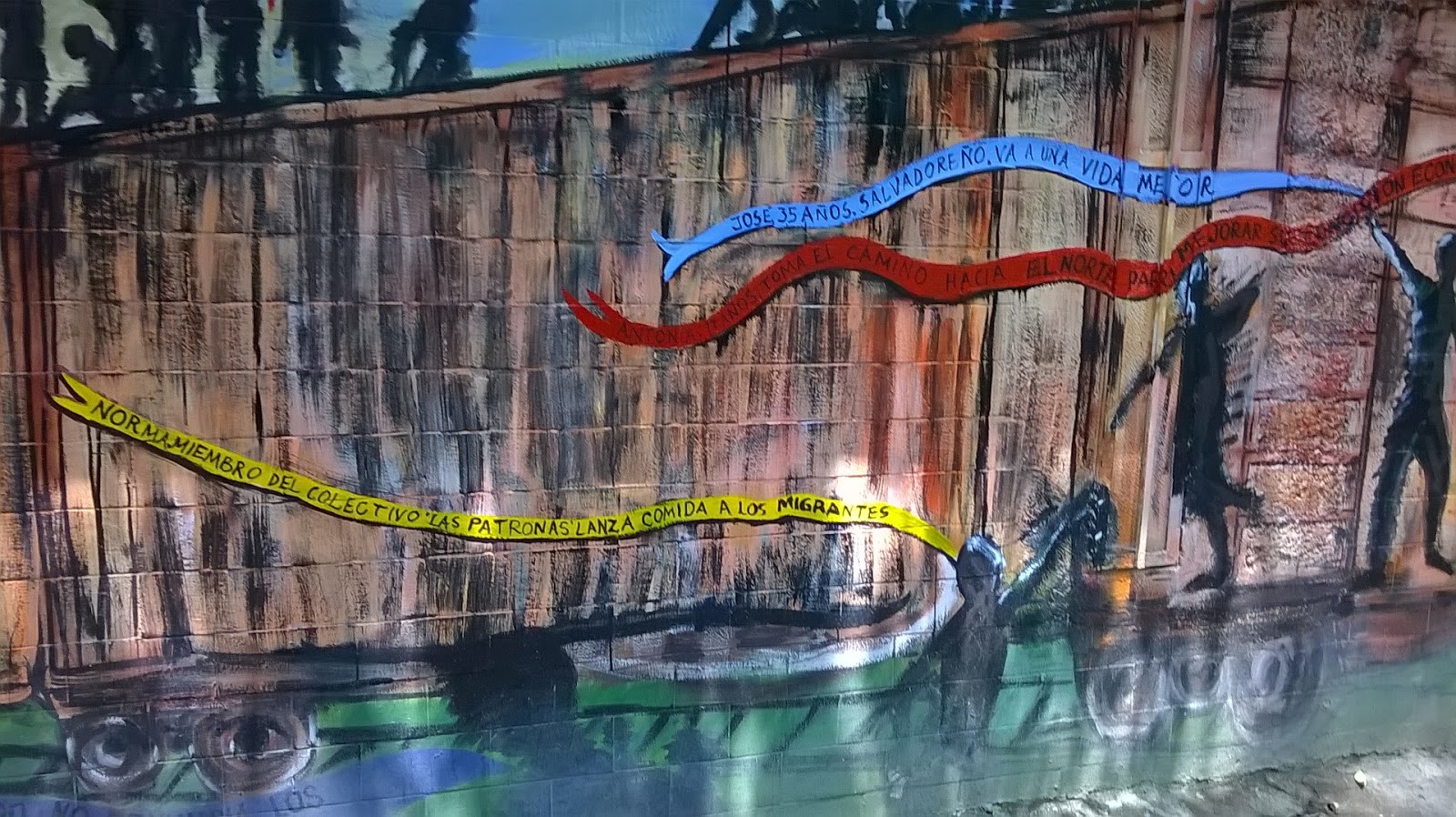
One of my favorite things about La Roma is the street art. It's used
 
to raise awareness for Central American refugees,


to encourage the community to care for the local park,


to accrue followers on instagram,

 
to advertise for concerts,


and, obviously, to portray humpback whales for the benefit of the general population.


Joshua, Naomi, and I had a couple of interesting talks about art - specifically, what makes art "good" and what makes it worthwhile. As I try to keep Mexico City alive in my spirit (read: sorting through photos, painting said photos, and sharing sketches of Mexico on this ancient blog of mine), I've been thinking back over those conversations.


A few things stand out to me:
 
 
1. The purpose of art matters. When a movie is supposed to be tragic but ends up making you laugh, it isn't good art.
 
2. God is an artist. Why all the different shapes, sizes, flavors, colors, sounds? Why music? Why laughter? There are a million things in the world that aren't necessary to sustain life, but certainly make life sweeter. Ecclesiastes 3:11 is a good verse to mull over: "He has made everything beautiful in its time. He has also set eternity in their heart, yet so that man will not find out the work which God has done from the beginning even to the end." Reading those words, I can imagine art as an endless process of rediscovery - unraveling the beauty God long ago embedded in human hearts.
 
3. Art is a way to see the world through another person's eyes.
 
"We're made so that we love
First when we see them painted, things we have passed
 Perhaps a hundred times nor cared to see;
And so they are better painted; better to us,
Which is the same thing. Art was given for that;
God uses us to help each other so,
Lending our minds out."
 -Fra Lippo Lippi, by Robert Browning
 
Maybe these three thoughts are true. Maybe they are not. For me, they add a depth to the street art in Mexico City, humpback whales and all. Tracing the lines God has already drawn - that’s what we are doing with our pencils and cameras and cans of spray paint.
 
Suppose with me these ideas are true. Then God, the Artist, has wrought His masterpiece (titled “The Heavens and the Earth”) with purpose, to evince His perspective. That is a thought that makes me want to spend more time looking up at the dusky sky and down at the slender blades of grass and around at the people at my kitchen table. Strange to think that these familiar fixtures in my world may be radiating the mind of God. And here I am, wishing I were back in the city where there is more stimulation... who knows what words Jesus might be whispering in the skies and yards and humans of suburban America!


Thursday, September 10, 2015

playgrounds, dying, and other important things

In El Laberinto De La Soledad (The Labyrinth of Solitude), Octavio Paz writes:
“Para el habitante de Nueva York, París, o Londres, la muerte es la palabra que jamás se pronuncia porque quema los labios. El mexicano, en cambia, la frecuenta, la burla...la festeja, es uno de sus juguetes favoritos y su amor más permanente.”
 "For the habitant of New York, Paris, or London, death is the word they never pronounce because it burns their lips. The Mexican, on the other hand, frequents it, jokes about it...celebrates it; it's one of his favorite toys and his most permanent love."

I believe Paz's assertion is proven by the playgrounds in Mexico City. Observe!


  1. Climbing wall coated in [very slippery] moss and surrounded by mud
  2. Treacherous, foot-trapping gaps between bricks
  3. Partial railing
  4. Flimsy bridge that a child's shoe can easily fit through (Selma figured that out for us)
  5. Log that appears to be a stable handhold but actually ROLLS if you put pressure on it, leaving you the choice of falling in the mud or straddling the metal bridge (credit for that discovery goes to Malachi)
  6. Thankfully, Malachi didn't discover the rusty iron nails sticking out of said log
But when you're not too preoccupied with safety, there are a plethora of ways to have fun! Like,


renting orange crates and sliding down steep concrete slopes,

 
climbing the trunks of colossal fallen trees,
 
 
finding creative ways to use the exercise equipment you're too short for,


 and sliding hand-in-hand into an enormous puddle (turning the heads of several Boy Scout troop leaders in the process).
 
Moral of the story: playgrounds that risk death are WAY more exciting than sterile plastic playscapes!
 
In all seriousness, though, the cultural acceptance and even embrace of death was one of the first things that drew my attention to Mexico. A major holiday, Día De Los Muertos (The Day of the Dead), is dedicated to remembering those who have died. My friends, both named Gabi, described the keeping of Día De Los Muertos to me as we strolled through Zona Rosa. Graves are festooned with flowers, altars with photographs of loved ones are set up in homes, and a special bread flavored with petals is baked and eaten. The holiday is not a day of mourning; it is a day of celebration.
 
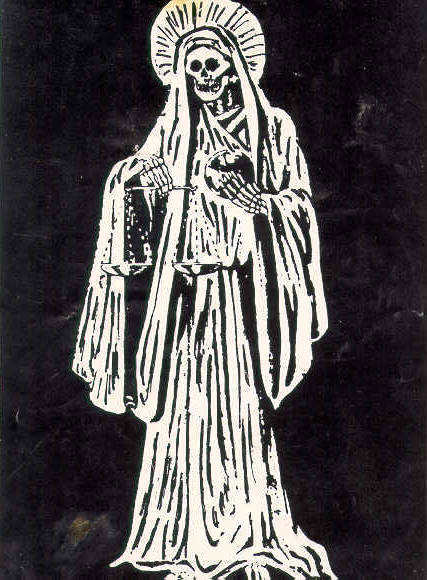
Celebrating death is foreign concept to me. Ocatvio Paz was right when he said that the word “death” seems to burn lips in the west. Maybe our prosperity has given us too much to live for, and we are afraid of losing what we have. La vida nos ha curado de espanto” (life has cured us of terror), Paz writes for the beleaguered Mexican. Then again, a worshipper of Santa Muerte (Saint Death) from the barrio of Tepito told David Lida that “to venerate death means that you adore life, because death is the only thing that can take life away from you.”
Día De Los Muertos and Santa Muerte herself come from prehispanic Mexica tradition. The Aztecs’ relationship with death was not love and not hatred; it was a dark infatuation.
La Catedral Metropolitana
 
La Catedral Metropolitana de México, consecrated in 1656, is built on top of the ruins of an Aztec temple. A week from yesterday, Naomi and I walked into La Catedral. (Every entrance but one was blocked off by security in preparation for a presidential address in the nearby old parliament building). Two windows of glass in the cathedral’s main plaza open to the subterranean remains of the temple. Seared in my memory is the image of two fossilized human skulls, embedded in the crumbling, golden-brown temple stones. Shoots of green sprout out through the skulls’ mouths, a strange mezcla (mix) of life and death. Those skulls are the remains of human sacrifice victims. For the Aztecs, death through sacrifice was necessary to appease the gods and maintain order in the universe – salud cósmica, Paz calls it.
The veneration of death has carried over into modern-day Mexico, not only in Día De Los Muertos but also in literal worship of Santa Muerte. In First Stop in the Twenty-First Century, David Lida describes a scene around the corner from the Tepito market:
“On the first day of each month the believers arrive en masse, setting plaster statues of Santa Muerte on tables or atop squares of fabric on the sidewalk. Hundreds of visitors walk around and leave treats for the saint at these makeshift altars - chocolate coins, fake currency, cigars, shots of rum, Barbie dolls. Others walk around with spray cans of cheap perfume, with which they literally douse the figurines. As the afternoon passes, the street becomes increasingly crowded. By nightfall when the prayers are chanted – ‘I come toward you prostrate, so that you will meet my needs; thank you for the favors I’ve received’ – there will be about five thousand people, blocking traffic on the surrounding streets…This hybrid of idol worship is a hybrid of Mexican popular culture with official Catholic dogma.”
Worship of a saint called Death, a grinning skeleton in a habit and a halo, strikes me as eerie. Maybe it makes you feel the same. How, then, does it make you feel to think that you might yourself be a worshipper of death?
Santa Muerte
 
“El culto a la vida, si de verdad es profundo y total, es también culto a la muerte,” writes Paz. “Es inútil excluir a la muerte de nuestras representaciones, de nuestras palabras, de nuestras ideas, porque ella acabará por suprimirnos a todos y en primer término a los que viven ignorándola o fingiendo que la ignoran.” The cult of life, if it is truly deep and complete, is also the cult of death. It’s useless to exclude death from our representations, our words, our ideas, because she will eventually remove us all, and first of all those who lived ignoring or pretending to ignore her.
When we live in denial of our own temporality, we are feeding an insatiable void. We our pouring our breath down the hollow ribcage of a cold, dry, loveless thing. Worshipping life – physical existence – for the sake of its own pleasure turns us into worshippers of Santa Muerte, even if the altar we have built to her is in front of our computers or in our hearts instead of in Tepito.
 
When I strolled through the streets of La Roma or stood on the apartment roof to watch the morning sun spread over Mexico City, I took it all in with greedy eyes. I tried to extract every last drop of beauty from the world around me and stuff it into my soul. But I was never satisfied. The streets blurred together in my memory; the sunrise was always too short. My appetite for life devoured every living thing it its pathway, including my joy.
 
The curious thing about life is that it will never be sweet until you hold it loosely and love it less than you love the One who made it beautiful.
 
Sunrise from the roof - Psalm 19