Showing posts with label image of God. Show all posts

Monday, May 23, 2016

it is well

Explaining to regular people why speech and debate tournaments are fun is extremely difficult. Yes, you’re wearing suits the whole time. Yes, you have to discuss dry topics like the federal court system for multiple hours a day. Yes, the schedule is so packed that you find yourself with five minutes to scarf down lunch in between rounds. But somehow, between the stress and – to put it bluntly – the sheer weirdness of tournaments, laughter and rich conversations abound. Friendships form quickly in the high-pressure environment of competition.


Ryan and I at our first practice tournament. It was at a corrective school for juvenile offenders...you should ask me for that story sometime ;)

Sweet NCFCA friends


These people never fail to make me laugh!
Considering how important tournaments had been in my life since sixth grade, I was surprised to find that I really didn’t miss them this year. As a matter of fact, when I spent time investing locally instead of prepping for and travelling to tournaments, I started to find the friendships, adventures, passions, and personal identity I spent so much of high school longing for. On a surface level, you could say this is because I cultivated deep roots in one place instead of trying to maintain dozens of long-distance connections. That’s true. But on a deeper level, I was happy because I stopped needing things like friendship, adventure, passion, and a personal identity. I just didn’t care that much anymore. After my wayward heart spent years wrestling with doubt and loneliness, I realized that I really didn’t want anything besides God.

When I felt most lonely, I looked to Him for companionship and learned that He was my best friend – the best friend I could ever ask for. When life seemed meaningless, I looked to Him for purpose and found in Him every reason I needed to charge joyfully ahead. Instead of expecting achievement to validate my existence or people to meet my emotional needs, my heart sang, “I am already filled, I have already become rich, I am already a king.” (1 Cor. 4:8) And, in accord with the beautifully backwards laws of God’s kingdom, I began to receive in abundance all the things I thought I had needed in the very moment I stopped needing them.

But as Mumford says, “this city breeds the plague of loving things more than their creator.” Now I wonder - have my affections relocated from God to the gifts He has given me? Do I really believe that I would be no better off if I had God and nothing else besides?

God has given me friendship. I love people – therefore I must be endlessly miserable as I try to look just right, act just right, and say all the right things to win people over.

God has given me work. I love feeling productive – therefore I must constantly push myself through crash-and-burn cycles of stress and exhaustion in order to accomplish things.

God has given me words. I love creating beauty with words – therefore I must feel as though I have no personal worth unless I can prove my superiority in the use of language.

God’s blessings quickly morph into perversely overinflated idols, making endless demands of us as they crouch on the thrones of our hearts. It’s not that we love them too much; it’s that we love God too little. We can free ourselves from these bloated blessings when we love Him more.

“Our heart is unquiet until it rests in you,” writes Augustine. This fits with the Christian axiom "rejoice in the Lord always." When our happiness is fixed on Christ our joy should be permanent because no one can take Him from us or us from Him. But the application of this principle is infinitely more difficult that its articulation. It is easy to love a friend who writes me beautiful letters and hugs me when I’m crying and makes me laugh. It is hard to love someone who I cannot touch, someone whose voice I have never audibly heard. As a human, I am so bound by my senses that it feels impossible to love something they cannot perceive. Such is the nature of this earthly city, which breeds the plague of loving tangible created things more than their transcendent Creator.

I am currently re-reading Genesis, which I find stranger and more wonderful each time I return to it. In the first few chapters of the Bible we hear about two particularly righteous men: Enoch and Noah. Both were saved from destruction – Enoch from physical death, Noah from the worldwide flood – because they found favor in God’s eyes. Why did they find favor? They “walked with God.” A brief visit to Strong’s Concordance suggests that walking with God does entail following His commandments. But it is also more than that. The same Hebrew word is used for “walked” and “went”, as in “Lot went with Abraham”, “Rebekah went with the servant,” and “Abraham was walking with his guests.” Walking with someone implies actually being with them. Walking with God does not simply mean you do what He says; it also means that you experience His presence in an interactive way.

As an introspective person, I relate strongly to St. Augustine. Sometimes I feel like I am reading about a more brilliant and spiritual version of myself when I read the Confessions. Here is how Augustine describes his thought life: “I questioned you about each thing, asking whether it existed, what it was, how highly it should be regarded; and all the while I listened to you teaching me and laying your commands upon me.” Augustine knew the meaning of walking with God. He willingly welcomed the Spirit into his consciousness, fusing his own mind with the mind of Christ.

The human thought process is an endless conversation with oneself. Augustine allowed his thought process to become an endless conversation with the Creator of the Universe. No wonder his mind was able to reach heights that make mine spin! From the inside out, Augustine surrendered his whole being to the influence of God. And so, even after losing his mother and several of his dearest friends, Augustine could write to his Lord: “Blessed is he who loves you, and loves his friend in you and his enemy for your sake. He alone loses no one dear to him, to whom all are dear in the One who is never lost.”

God has richly given us all good things to enjoy (1 Timothy 6:17). But the world can only be rightly enjoyed if we love it through Christ, in whom all things hold together. The things of this world are intrinsically brief. They are made to be beautiful in their passing, just as a spoken sentence has meaning only when one sound dies away to make room for the next. A heart fixed on transient things will experience constant death as the things it loves passes away. A heart fixed on Christ can say, as Augustine said, “Praise God for the beauty of corporeal things, and channel the love you feel for them onto their Maker…If kinship with other souls appeals to you, let them be loved in God…and carry off to God as many of them as possible with you, and say to them, ‘Let us love Him, for He made these things and He is not far off.’”

God has given me friendship. I love people – therefore I will thank God for the people in my life and do everything I can to draw them closer to Him.

God has given me work. I love feeling productive – therefore I will prioritize the tasks that matter most to Him and trust that He will work everything out when the body He has given me needs rest.

God has given me words. I love creating beauty with words – therefore I will use my mouth and my pen (or my computer!) to exalt Him.

Friends desert us, work unravels, computers crash, but if we have loved these things in Christ, none of our affection is wasted. Our love for these blessings has brought us nearer to God, opening springs of delight in us and in Him.

Returning to the world of speech and debate tournaments: I visited regionals at the beginning of this month. After the tournament ended, I was a saltwater wreck - black mascara tears and all. Of course, I will stay in touch with some of my NCFCA friends, but there are literally not enough hours in a day or days in a year to keep up with everyone. And in a sense, I love everyone. Each person’s presence affects the atmosphere of an entire tournament, so that the difference is acute when even one person isn’t there. I will miss each person’s unique presence in my life. And as the departure of San Antonio friends to their respective schools fast approaches, I can sometimes feel myself becoming melancholy, maybe even afraid of the change.

I’m glad I feel sad when people aren’t around - it means that I actually like them. But the sadness should not be ensnaring; it should not become a “slough of despond”. My friends are all safe in the hand of God. I can trust that our time together is made more beautiful by Him in its very passing away. And who knows when He will choose to snatch us up from the four corners of the earth and weave us back into each other’s lives. “All manner of things shall be well” in His time.

I long for my thought life to become a conversation with God so that I can see from His perspective, acting and speaking with His love. I have such a long way to go, but I am excited for the journey.

For now, thank you, dear friends, for being in my life. I hope we learn to cherish Christ in each other and each other in Christ.
 
CrossLife seniors

Wednesday, January 20, 2016

κοινωνία

Christmas break was a different kind of animal this year. I alternated between being so busy that I forgot to eat (if you know me, you know how weird that is) and reading Harry Potter for hours on end in odd corners of my house (because, obviously, books are just more enjoyable when read upside-down on the staircase landing).

I also learned a lot. I learned about the Church and the Mayans and Hogwarts, thanks to God’s creativity in making different kinds of people and people’s creativity in writing different kinds of books. But mostly, I learned about myself. At the end of break, I wrote down 7 “life facts” I had either forgotten or never realized before. Here’s #3:

“The closer I get to someone, the messier the relationship becomes. But it also gets better.”

I think this homely but heartfelt sentence can be expanded on a grand scale. Getting close to anything means giving it permission to hurt you. I feel the ache of loss every time I volunteer at the refugee shelter downtown. For a few hours, I talk with, eat with, play with, and sometimes nearly cry with a bundle of precious souls. Then, they climb into a van which takes them to a bus which, eventually, takes them a thousand miles away. Here is what I wrote one afternoon after coming back from the shelter:

“I can still see Erica and Andrés’ faces pressed against the thickly-screened window. They are smiling and waving. Tomorrow, they will be in another state, and they will forget the girl who made beds, swept, watched ‘Finding Nemo’, and danced in front of the security cameras with them. Now I have their names with their faces and personalities still fresh and attached. But the more tender, living memories, the emotions and mannerisms, will slowly be taken from me. Only names will stay behind, like fossils imprinted on rock: concepts defined by empty space, feeding on absence. It does not feel beautiful to me right now, the way we touch each other’s lives. So much of me is lost with each person I encounter.”

If I could go back to time and talk to the Aubrey who wrote that paragraph, I would tell her that it’s good she felt something when Erica and Andrés left because it meant she cared about them. I would also tell her that the presence of pain does not mean the absence of beauty. Closeness means opening your heart, which means hurt, but also means fulfillment.

Maybe I should put it this way…

One item tops my virtual lists of character flaws, discouragements, joy-killers, lifelong struggles, etc. This slithering sin has tyrannized me and poisoned life’s sweetest moments. Its name is selfishness.

I have long agreed with G. K. Chesterton – “how much larger your life would be if your self could become smaller in it” – but I am also very bad at making myself small. Thus, I can spoil a lovely day by snapping at a family member who interrupts my study time. I can suck all the healing out of words spoken to a struggling friend by contemplating how gentle and sympathetic I must look. I can and do repent of these failures, but I also repeat them. Again and again and again.

Today, it dawned on me. I finally realized the full impact of a truth my parents have taught me since I was little: put off and put on. It’s not enough to put off selfishness; more selfishness will rush in to fill the void. I need to also put on love.

And what is love? Most would agree that love has to be more than a feeling if it is to last for any length of time. But love must also be more than an action – I know because I have “served” my brothers on many occasions (such as by picking up their LEGO bricks which, only moments before, impaled my bare foot) without expending so much as one-sixteenth of a milliliter of goodwill.

I do not dare to pretend that I fully grasp what love is. I’m sure there are as many sides to it as there are thoughts in Dumbledore’s pensieve. But as I mull over passages like 1st Corinthians 13 and 1st John 1-5, I become more and more convinced that at least in part, love is identifying with someone else to the extent that their good becomes my good. That’s why love is patient: if controlling my tongue is the difference between blessing and wounding my friend, then I am happy to do it. Love isn’t jealous: if spending time with someone else helps her to grow, I’ll gladly relinquish my claim on her schedule.

I believe that communion – κοινωνία, sharing, fellowship – is central to love. Jesus didn’t just write us a certification for cancellation of sins; He took on our decaying flesh, shared in our sufferings, experienced our temptations, and became sin for us (2 Cor. 5:21). Jesus’ method of redemption was a sharing of identity - His righteousness for ours, ours for His. And His prayer for the believers He left behind was a plea for unity: “that they may all be one; even as You, Father, are in Me, and I in You, that they also may be in Us” (John 17:21). This communion is something Jesus’ first followers preserved: the church devoted itself to fellowship (Acts 2:42), and Paul shared his own soul with his beloved Thessalonians (1 Thess. 2:8).

Now I press a few buttons in my mental elevator and descend from the abstract to the personal level.

It’s comfortable to hold people at arm’s length, because they can’t hurt me if I don’t need them. It’s nicer to share articles about refugees on Facebook than to spend three hours cleaning up a play room that fifty-something children have passed through. I feel safer when I spill my thoughts in a private journal than when I let my acquaintances see that I am weak and flawed. So I do not commune, I do not share my soul.

And then what?

“The modern man does not immerse himself in anything he does,” wrote Octavio Paz. “Always, a part of him remains intact and alert…The solitude that this engenders…is a total condemnation, a mirror of a world without escape.”

What we might call being reserved or independent is often a hyper-individualism that shuts us up inside of ourselves. When I protect myself instead of giving myself away, I am locked into a room of mirrors. I cannot see what is true, beautiful, good, and eternal; I only see my own reflection staring angrily from every nook and cranny of this world without escape, reminding me of all that I fail to be. I am condemned to confinement within my own mind.

Life is meant to be shared. Specifically, it is meant to be shared through Christ. When we come to people through the One who became like us to save us, we don’t have to fight for self-preservation or pleasure. Christ has already given Himself unreservedly to us. And in His presence we find fullness of joy (Psalm 16:11).

This is why beauty and pain coexist when souls collide. This is why relationships can get better and messier at the same time. Communion requires a surrender of self to others, a death of desire. And death, of course, causes pain. But dying to self is a way of imitating what Jesus did for us, of sharing in His sufferings.

Communion with others flings ten thousand doors open, letting us explore the new and unimagined wonders God has placed inside of each person. It splits our little worlds apart so that we are aware not just of ourselves, but also of the star-like souls that fill this madly spinning planet and of the One who spoke them all into being.

My ambition for 2016 is to love well, to make the good of other people my own good, to live not in fear of loss but in anticipation of grace. And thus item #5 on my life-fact list:

“I am part of God’s story and my life isn’t just made for me; it’s made to fit in other peoples’ lives. Sometimes I glimpse the big picture, sort of like when Harry and Hermione time-travel in Book 3 and finally understand why everything happened the way it did. That makes me happy.”

Oh, and lest you think I spent my entire break drawing analogies between spiritual truths and Harry Potter, let me give you #1 on the list:

“I love bugs.”

Do with it as you will ;)

Love as always,

Aubrey


Sweet Adelaide is...


...a beautiful soul...


...who knows how to delight in the world.

Wednesday, October 28, 2015

forward regression


Thus far this week I have managed to:
 

-Talk when I should have listened

-Spend half a sermon thinking about how badly I need to go shopping and how much I hate shopping (it's a vicious cycle)

-Fail someone I love not once, but twice in the same day

-Make and break a new schedule within 24 consecutive hours

-Freak out about college applications I should have taken care of sooner

-Get irritated with the people I love most in the whole world

-Feel really lame for having these problems
 

(Hi, welcome to my life!)

 ~

As I slowly sunk into this quagmire of failure, Piper's words hit me like a lifeline:
 

"Shame is a painful emotion caused by a consciousness of guilt or shortcoming or impropriety. The pain is caused not merely by our own failures but by the awareness that others see them."

          [John Piper]


At first, the quote might seem more condemning than redemptive: **sarcasm alert** "So, not only am I guilty, but I only feel the guilt because I'm worried about what other people think? Guilty and egotistical. Great! I feel so much better about myself now!!"
 

(Actually, I felt a lot worse.)
 

 Truth has a razor-sharp edge; it pierces and burns before it heals.

 ~

 Of course, I don't enjoy messing up. But it's easy to dismiss my shortcomings as mere mistakes and to flippantly say that I'll "do better next time" - unless I am aware that others saw what I did wrong. Then, my failures afflict me. I am burdened, I feel ashamed; I might even weep. But I weep because I see myself through the eyes of other people and find I am not all I wish to be.

~

I like to play with reality. When I take walks, I spin and re-spin the story of my life (present, past, future) in beautiful words. I draw on real events, embellishing them to make myself sometimes tragic, sometimes amusing, but always picturesque. Always the heroine.

And the funny thing is, I keep telling myself those stories even though they make me miserable. They make me miserable because they never come true. I know they never will.

~

Here we come to a very quiet place.

Imagine somewhere like spring. Small white flowers are dusted over the grass, a sort of starry powder. The flowers turn their little faces to the sun and open slowly, so slowly that you would never see their petals uncurl and stretch to meet the morning. They have so recently sprung from the soil.
 

the leap,

the purge, the quick humility

of witnessing a birth


That’s what Kay Ryan said. When I tried to explain the feeling back in March, I said this:


There is a richness underground, a sort of historical wisdom –


         A humility in these springtime stars.


I like Kay Ryan’s words better, but that’s beside the point. Here’s what struck me: I’m not the only one who associates birth and humility. It’s me, Kay Ryan the poet of sunshine, and someone else…

~

…that would be Jesus.
 

“And He called a child to Himself and set him before them, and said, ‘Truly I say to you, unless you are converted and become like children, you will not enter the kingdom of heaven. Whoever then humbles himself as this child, he is the greatest in the kingdom of Heaven.” –Matthew 18:2-4.


I spend so much time trying to be a parent-figure, a mentor-figure, a hero-figure. Constantly, I seek to mold myself into someone of worth and significance. I suppose that is not all bad.

But I spend so little time being comforted because someone who loves me and who is stronger than me says everything is going to be OK. These days, I don’t often squeal with delight because “GUYSthere’saLIZARDonthewindow” (always pronounced without spacing). When was the last time I sobbed because a baby bird fell out of his nest? And what happened to the times I hugged crying people instead of listing off ways for them to fix their problems?

Peace, wonder, tenderness, compassion - childlike traits. And they come because children are small, know they are small, and are content to be small. A child is happily subordinate. A child trusts without understanding.

There is such freedom, such rest, in not being at the center of all my stories. It’s lovely to know someone much more competent than I am will save the day.

~

Here is where we find the gentle side of truth.

I have plenty of failures. Layers upon layers of them, and we’re still peeling! (I say we, because it’s a collaborative effort between God, the world, and myself). But when I can acknowledge those failures and lay them at Jesus’ feet with a spirit of genuine repentance and childlike trust, there is rest. When faith lets me see the world through God’s eyes (not others’ eyes, least of all my own), I am freed from this shackling shame.

By the grace of God, I will be a child.

 
artsy picture

artsy picture

 
realistic picture

PC to Renee, who is wonderful
 
 
“O Lord, my heart is not proud, nor my eyes haughty;
Nor do I involve myself in great matters,
Or in things too difficult for me.
Surely I have composed and quieted my soul;
Like a weaned child rests against his mother,
My soul is like a weaned child within me.”
[Psalm 131:1-2]


Saturday, September 12, 2015

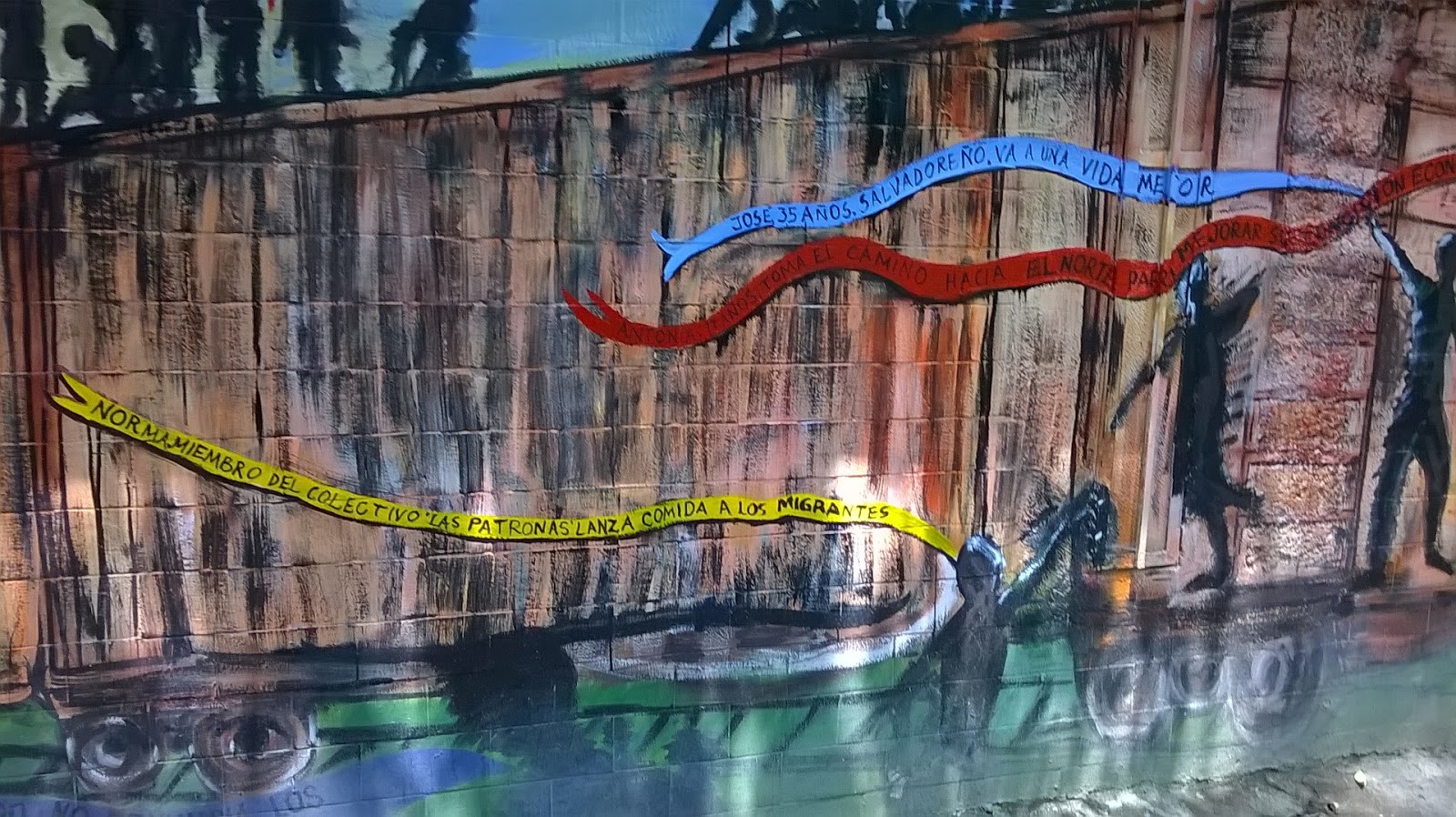
celestial spray paint

One of my favorite things about La Roma is the street art. It's used
 
to raise awareness for Central American refugees,


to encourage the community to care for the local park,


to accrue followers on instagram,

 
to advertise for concerts,


and, obviously, to portray humpback whales for the benefit of the general population.


Joshua, Naomi, and I had a couple of interesting talks about art - specifically, what makes art "good" and what makes it worthwhile. As I try to keep Mexico City alive in my spirit (read: sorting through photos, painting said photos, and sharing sketches of Mexico on this ancient blog of mine), I've been thinking back over those conversations.


A few things stand out to me:
 
 
1. The purpose of art matters. When a movie is supposed to be tragic but ends up making you laugh, it isn't good art.
 
2. God is an artist. Why all the different shapes, sizes, flavors, colors, sounds? Why music? Why laughter? There are a million things in the world that aren't necessary to sustain life, but certainly make life sweeter. Ecclesiastes 3:11 is a good verse to mull over: "He has made everything beautiful in its time. He has also set eternity in their heart, yet so that man will not find out the work which God has done from the beginning even to the end." Reading those words, I can imagine art as an endless process of rediscovery - unraveling the beauty God long ago embedded in human hearts.
 
3. Art is a way to see the world through another person's eyes.
 
"We're made so that we love
First when we see them painted, things we have passed
 Perhaps a hundred times nor cared to see;
And so they are better painted; better to us,
Which is the same thing. Art was given for that;
God uses us to help each other so,
Lending our minds out."
 -Fra Lippo Lippi, by Robert Browning
 
Maybe these three thoughts are true. Maybe they are not. For me, they add a depth to the street art in Mexico City, humpback whales and all. Tracing the lines God has already drawn - that’s what we are doing with our pencils and cameras and cans of spray paint.
 
Suppose with me these ideas are true. Then God, the Artist, has wrought His masterpiece (titled “The Heavens and the Earth”) with purpose, to evince His perspective. That is a thought that makes me want to spend more time looking up at the dusky sky and down at the slender blades of grass and around at the people at my kitchen table. Strange to think that these familiar fixtures in my world may be radiating the mind of God. And here I am, wishing I were back in the city where there is more stimulation... who knows what words Jesus might be whispering in the skies and yards and humans of suburban America!


Saturday, March 23, 2013

Lover of Light


     I finally finished Les Miserables. When I started it a few months ago, I thought I would never finish. Ryan and I counted: EIGHTY-SIX Kindle pages for ONE PERCENT of the book! And when I finished, I wished it would never end. Les Mis is one of the most beautiful, powerful books I have ever read. Victor Hugo examines the world through the lens of man's soul. The lens isn't rose-colored; Hugo lays bare the depravity of our disfigured human hearts, and the lies and atrocities proceeding from them. But at the same time, Les Mis does not abide in the shadows.

     Probably the most heart-wrenching storyline is Fantine's. Fantine sold her hair, her teeth, and her love to provide for her estranged daughter Cossette. The people of Montreuil-sur-Mer saw the gaps in Fantine's mouth and pronounced her grotesque. They saw her on the prostitute's corner and, in all their moral virtuosity, declared her disgraceful. Everyone who could have lifted her up instead passed by with averted eyes. I wept, because I saw the whole picture of Fantine's life. I saw that Fantine was used and abandoned by Cossette's father. I saw that she had placed her daughter with a foster family to keep her from the shame of illgitimacy. I saw that she was decieved into believing that her Cossette was desperately ill and in need of expensive medicine. I saw Cossette in perfect health, being used for slave labor while Fantine's money lined the pockets of a criminal innkeeper. I saw the sacrificial love for her daughter that Fantine lived by. But the townspeople only saw the shame Fantine had been forced into, and the hatred their shunning spawned in her. Hugo writes, "Those who do not see, do not weep."

     There are so many things we do not see. I don't know the stories of the people who sit on off Judson Road with misspelled signs, or the homeless man whose eyes I saw peering out from a pile of cardboard and towels under a downtown bridge, or the rude old man in the grocery store, or the barely dressed girl in Wal-Mart. Certainly they are sinners. We all are. There was a great deal of darkness in Fantine. But somewhere in Fantine, in those broken people around me, is a light, a trace of the image of God. I want to see their pain, their stories, their hidden light. I want to be a part of bringing out that light, seeing it redeemed, like Monsieur Madeline rescued Fantine and brought out her light.

     2nd Corinthians 5:16 says, "From now on" [now that the love of Christ controls us] "we regard no one according to the flesh". We don't see people the same way. Verse 18: "All this is from God, who through Christ reconciled us to Himself and gave us the ministry of reconciliation." Through Christ, God has brought me back to Himself and given me new life. Now it is my blessing and duty, granted by Him, to bring people to His "wonderful light" (1st Peter 2:9).I cannot see everything, but I know the Light, and because of my great God I can see Him everywhere, even in the blackest corners of the blackest souls.

I will strive to be a Lover of the Light.

Tuesday, March 12, 2013

Art as Imitation

     This year, I've been able to teach art to my younger brothers, and some of my cousins. I'm not even really a very good artist-I started drawing because it was something my brother could do better than me, and Heaven forbid that! But I do love painting, and I have a tiny bit of knowledge to pass on.


            Art is what I'm drawn to-literature most of all, but drawing and painting and music have their place in my heart, too. If I have free time, I hole up in my room with my violin or pencil or most often laptop to materialize the ideas in my head. But I came to a point where I started to wonder, is this a waste? As a Christian, I am "called to proclaim the excellencies of Him who called [me] out of darkness into His wonderful light" (1st Peter 2:9). Artistic expression is fun. It's invigorating and freeing. But in the end, isn't it just selfish indulgence, like watching TV or wasting time on Facebook? Shouldn't I  be out preaching the Gospel instead?

The answer is yes, and no.

    The goal is to glorify God, to proclaim His excellencies. Preaching the Gospel is absolutely one of the most important ways to do that, but it isn't the only way. Colossians 3:17 says "whether you eat or drink or whatever you do, do all to the glory of God". Eating and drinking can glorify God. So can art.

    God is an artist, a Creator. He "formed me in my mother's womb" (Psalm 139). The sky is declaring his handiwork (Psalm 19).


He fashioned this ladybug, and


He delighted in sculpting this little cutie.

    Edith Schaeffer was so right when she said, "A Christian, who realizes that he has been made in the image of the Creator God...[is] meant to be creative on a finite level."

     I can write words that tell of God's greatness, and weave stories that point people to Him. I'm doing a Bible study with a girl in my neighborhood, and when we get together, we're going to paint. Whether your art is soccer 

or water polo

or ballet

or carpentry

or drawing 

or harmonica playing 

or baking 

or interior decorating, you can use it to draw people in: into yourself, or into God. God who gave you the abilities. God who is the first Creator, and who everyone, whether they realize it or not, creates in imitation of.