Showing posts with label friends. Show all posts

Monday, May 23, 2016

it is well

Explaining to regular people why speech and debate tournaments are fun is extremely difficult. Yes, you’re wearing suits the whole time. Yes, you have to discuss dry topics like the federal court system for multiple hours a day. Yes, the schedule is so packed that you find yourself with five minutes to scarf down lunch in between rounds. But somehow, between the stress and – to put it bluntly – the sheer weirdness of tournaments, laughter and rich conversations abound. Friendships form quickly in the high-pressure environment of competition.


Ryan and I at our first practice tournament. It was at a corrective school for juvenile offenders...you should ask me for that story sometime ;)

Sweet NCFCA friends


These people never fail to make me laugh!
Considering how important tournaments had been in my life since sixth grade, I was surprised to find that I really didn’t miss them this year. As a matter of fact, when I spent time investing locally instead of prepping for and travelling to tournaments, I started to find the friendships, adventures, passions, and personal identity I spent so much of high school longing for. On a surface level, you could say this is because I cultivated deep roots in one place instead of trying to maintain dozens of long-distance connections. That’s true. But on a deeper level, I was happy because I stopped needing things like friendship, adventure, passion, and a personal identity. I just didn’t care that much anymore. After my wayward heart spent years wrestling with doubt and loneliness, I realized that I really didn’t want anything besides God.

When I felt most lonely, I looked to Him for companionship and learned that He was my best friend – the best friend I could ever ask for. When life seemed meaningless, I looked to Him for purpose and found in Him every reason I needed to charge joyfully ahead. Instead of expecting achievement to validate my existence or people to meet my emotional needs, my heart sang, “I am already filled, I have already become rich, I am already a king.” (1 Cor. 4:8) And, in accord with the beautifully backwards laws of God’s kingdom, I began to receive in abundance all the things I thought I had needed in the very moment I stopped needing them.

But as Mumford says, “this city breeds the plague of loving things more than their creator.” Now I wonder - have my affections relocated from God to the gifts He has given me? Do I really believe that I would be no better off if I had God and nothing else besides?

God has given me friendship. I love people – therefore I must be endlessly miserable as I try to look just right, act just right, and say all the right things to win people over.

God has given me work. I love feeling productive – therefore I must constantly push myself through crash-and-burn cycles of stress and exhaustion in order to accomplish things.

God has given me words. I love creating beauty with words – therefore I must feel as though I have no personal worth unless I can prove my superiority in the use of language.

God’s blessings quickly morph into perversely overinflated idols, making endless demands of us as they crouch on the thrones of our hearts. It’s not that we love them too much; it’s that we love God too little. We can free ourselves from these bloated blessings when we love Him more.

“Our heart is unquiet until it rests in you,” writes Augustine. This fits with the Christian axiom "rejoice in the Lord always." When our happiness is fixed on Christ our joy should be permanent because no one can take Him from us or us from Him. But the application of this principle is infinitely more difficult that its articulation. It is easy to love a friend who writes me beautiful letters and hugs me when I’m crying and makes me laugh. It is hard to love someone who I cannot touch, someone whose voice I have never audibly heard. As a human, I am so bound by my senses that it feels impossible to love something they cannot perceive. Such is the nature of this earthly city, which breeds the plague of loving tangible created things more than their transcendent Creator.

I am currently re-reading Genesis, which I find stranger and more wonderful each time I return to it. In the first few chapters of the Bible we hear about two particularly righteous men: Enoch and Noah. Both were saved from destruction – Enoch from physical death, Noah from the worldwide flood – because they found favor in God’s eyes. Why did they find favor? They “walked with God.” A brief visit to Strong’s Concordance suggests that walking with God does entail following His commandments. But it is also more than that. The same Hebrew word is used for “walked” and “went”, as in “Lot went with Abraham”, “Rebekah went with the servant,” and “Abraham was walking with his guests.” Walking with someone implies actually being with them. Walking with God does not simply mean you do what He says; it also means that you experience His presence in an interactive way.

As an introspective person, I relate strongly to St. Augustine. Sometimes I feel like I am reading about a more brilliant and spiritual version of myself when I read the Confessions. Here is how Augustine describes his thought life: “I questioned you about each thing, asking whether it existed, what it was, how highly it should be regarded; and all the while I listened to you teaching me and laying your commands upon me.” Augustine knew the meaning of walking with God. He willingly welcomed the Spirit into his consciousness, fusing his own mind with the mind of Christ.

The human thought process is an endless conversation with oneself. Augustine allowed his thought process to become an endless conversation with the Creator of the Universe. No wonder his mind was able to reach heights that make mine spin! From the inside out, Augustine surrendered his whole being to the influence of God. And so, even after losing his mother and several of his dearest friends, Augustine could write to his Lord: “Blessed is he who loves you, and loves his friend in you and his enemy for your sake. He alone loses no one dear to him, to whom all are dear in the One who is never lost.”

God has richly given us all good things to enjoy (1 Timothy 6:17). But the world can only be rightly enjoyed if we love it through Christ, in whom all things hold together. The things of this world are intrinsically brief. They are made to be beautiful in their passing, just as a spoken sentence has meaning only when one sound dies away to make room for the next. A heart fixed on transient things will experience constant death as the things it loves passes away. A heart fixed on Christ can say, as Augustine said, “Praise God for the beauty of corporeal things, and channel the love you feel for them onto their Maker…If kinship with other souls appeals to you, let them be loved in God…and carry off to God as many of them as possible with you, and say to them, ‘Let us love Him, for He made these things and He is not far off.’”

God has given me friendship. I love people – therefore I will thank God for the people in my life and do everything I can to draw them closer to Him.

God has given me work. I love feeling productive – therefore I will prioritize the tasks that matter most to Him and trust that He will work everything out when the body He has given me needs rest.

God has given me words. I love creating beauty with words – therefore I will use my mouth and my pen (or my computer!) to exalt Him.

Friends desert us, work unravels, computers crash, but if we have loved these things in Christ, none of our affection is wasted. Our love for these blessings has brought us nearer to God, opening springs of delight in us and in Him.

Returning to the world of speech and debate tournaments: I visited regionals at the beginning of this month. After the tournament ended, I was a saltwater wreck - black mascara tears and all. Of course, I will stay in touch with some of my NCFCA friends, but there are literally not enough hours in a day or days in a year to keep up with everyone. And in a sense, I love everyone. Each person’s presence affects the atmosphere of an entire tournament, so that the difference is acute when even one person isn’t there. I will miss each person’s unique presence in my life. And as the departure of San Antonio friends to their respective schools fast approaches, I can sometimes feel myself becoming melancholy, maybe even afraid of the change.

I’m glad I feel sad when people aren’t around - it means that I actually like them. But the sadness should not be ensnaring; it should not become a “slough of despond”. My friends are all safe in the hand of God. I can trust that our time together is made more beautiful by Him in its very passing away. And who knows when He will choose to snatch us up from the four corners of the earth and weave us back into each other’s lives. “All manner of things shall be well” in His time.

I long for my thought life to become a conversation with God so that I can see from His perspective, acting and speaking with His love. I have such a long way to go, but I am excited for the journey.

For now, thank you, dear friends, for being in my life. I hope we learn to cherish Christ in each other and each other in Christ.
 
CrossLife seniors

Wednesday, January 20, 2016

κοινωνία

Christmas break was a different kind of animal this year. I alternated between being so busy that I forgot to eat (if you know me, you know how weird that is) and reading Harry Potter for hours on end in odd corners of my house (because, obviously, books are just more enjoyable when read upside-down on the staircase landing).

I also learned a lot. I learned about the Church and the Mayans and Hogwarts, thanks to God’s creativity in making different kinds of people and people’s creativity in writing different kinds of books. But mostly, I learned about myself. At the end of break, I wrote down 7 “life facts” I had either forgotten or never realized before. Here’s #3:

“The closer I get to someone, the messier the relationship becomes. But it also gets better.”

I think this homely but heartfelt sentence can be expanded on a grand scale. Getting close to anything means giving it permission to hurt you. I feel the ache of loss every time I volunteer at the refugee shelter downtown. For a few hours, I talk with, eat with, play with, and sometimes nearly cry with a bundle of precious souls. Then, they climb into a van which takes them to a bus which, eventually, takes them a thousand miles away. Here is what I wrote one afternoon after coming back from the shelter:

“I can still see Erica and Andrés’ faces pressed against the thickly-screened window. They are smiling and waving. Tomorrow, they will be in another state, and they will forget the girl who made beds, swept, watched ‘Finding Nemo’, and danced in front of the security cameras with them. Now I have their names with their faces and personalities still fresh and attached. But the more tender, living memories, the emotions and mannerisms, will slowly be taken from me. Only names will stay behind, like fossils imprinted on rock: concepts defined by empty space, feeding on absence. It does not feel beautiful to me right now, the way we touch each other’s lives. So much of me is lost with each person I encounter.”

If I could go back to time and talk to the Aubrey who wrote that paragraph, I would tell her that it’s good she felt something when Erica and Andrés left because it meant she cared about them. I would also tell her that the presence of pain does not mean the absence of beauty. Closeness means opening your heart, which means hurt, but also means fulfillment.

Maybe I should put it this way…

One item tops my virtual lists of character flaws, discouragements, joy-killers, lifelong struggles, etc. This slithering sin has tyrannized me and poisoned life’s sweetest moments. Its name is selfishness.

I have long agreed with G. K. Chesterton – “how much larger your life would be if your self could become smaller in it” – but I am also very bad at making myself small. Thus, I can spoil a lovely day by snapping at a family member who interrupts my study time. I can suck all the healing out of words spoken to a struggling friend by contemplating how gentle and sympathetic I must look. I can and do repent of these failures, but I also repeat them. Again and again and again.

Today, it dawned on me. I finally realized the full impact of a truth my parents have taught me since I was little: put off and put on. It’s not enough to put off selfishness; more selfishness will rush in to fill the void. I need to also put on love.

And what is love? Most would agree that love has to be more than a feeling if it is to last for any length of time. But love must also be more than an action – I know because I have “served” my brothers on many occasions (such as by picking up their LEGO bricks which, only moments before, impaled my bare foot) without expending so much as one-sixteenth of a milliliter of goodwill.

I do not dare to pretend that I fully grasp what love is. I’m sure there are as many sides to it as there are thoughts in Dumbledore’s pensieve. But as I mull over passages like 1st Corinthians 13 and 1st John 1-5, I become more and more convinced that at least in part, love is identifying with someone else to the extent that their good becomes my good. That’s why love is patient: if controlling my tongue is the difference between blessing and wounding my friend, then I am happy to do it. Love isn’t jealous: if spending time with someone else helps her to grow, I’ll gladly relinquish my claim on her schedule.

I believe that communion – κοινωνία, sharing, fellowship – is central to love. Jesus didn’t just write us a certification for cancellation of sins; He took on our decaying flesh, shared in our sufferings, experienced our temptations, and became sin for us (2 Cor. 5:21). Jesus’ method of redemption was a sharing of identity - His righteousness for ours, ours for His. And His prayer for the believers He left behind was a plea for unity: “that they may all be one; even as You, Father, are in Me, and I in You, that they also may be in Us” (John 17:21). This communion is something Jesus’ first followers preserved: the church devoted itself to fellowship (Acts 2:42), and Paul shared his own soul with his beloved Thessalonians (1 Thess. 2:8).

Now I press a few buttons in my mental elevator and descend from the abstract to the personal level.

It’s comfortable to hold people at arm’s length, because they can’t hurt me if I don’t need them. It’s nicer to share articles about refugees on Facebook than to spend three hours cleaning up a play room that fifty-something children have passed through. I feel safer when I spill my thoughts in a private journal than when I let my acquaintances see that I am weak and flawed. So I do not commune, I do not share my soul.

And then what?

“The modern man does not immerse himself in anything he does,” wrote Octavio Paz. “Always, a part of him remains intact and alert…The solitude that this engenders…is a total condemnation, a mirror of a world without escape.”

What we might call being reserved or independent is often a hyper-individualism that shuts us up inside of ourselves. When I protect myself instead of giving myself away, I am locked into a room of mirrors. I cannot see what is true, beautiful, good, and eternal; I only see my own reflection staring angrily from every nook and cranny of this world without escape, reminding me of all that I fail to be. I am condemned to confinement within my own mind.

Life is meant to be shared. Specifically, it is meant to be shared through Christ. When we come to people through the One who became like us to save us, we don’t have to fight for self-preservation or pleasure. Christ has already given Himself unreservedly to us. And in His presence we find fullness of joy (Psalm 16:11).

This is why beauty and pain coexist when souls collide. This is why relationships can get better and messier at the same time. Communion requires a surrender of self to others, a death of desire. And death, of course, causes pain. But dying to self is a way of imitating what Jesus did for us, of sharing in His sufferings.

Communion with others flings ten thousand doors open, letting us explore the new and unimagined wonders God has placed inside of each person. It splits our little worlds apart so that we are aware not just of ourselves, but also of the star-like souls that fill this madly spinning planet and of the One who spoke them all into being.

My ambition for 2016 is to love well, to make the good of other people my own good, to live not in fear of loss but in anticipation of grace. And thus item #5 on my life-fact list:

“I am part of God’s story and my life isn’t just made for me; it’s made to fit in other peoples’ lives. Sometimes I glimpse the big picture, sort of like when Harry and Hermione time-travel in Book 3 and finally understand why everything happened the way it did. That makes me happy.”

Oh, and lest you think I spent my entire break drawing analogies between spiritual truths and Harry Potter, let me give you #1 on the list:

“I love bugs.”

Do with it as you will ;)

Love as always,

Aubrey


Sweet Adelaide is...


...a beautiful soul...


...who knows how to delight in the world.

Wednesday, October 28, 2015

forward regression


Thus far this week I have managed to:
 

-Talk when I should have listened

-Spend half a sermon thinking about how badly I need to go shopping and how much I hate shopping (it's a vicious cycle)

-Fail someone I love not once, but twice in the same day

-Make and break a new schedule within 24 consecutive hours

-Freak out about college applications I should have taken care of sooner

-Get irritated with the people I love most in the whole world

-Feel really lame for having these problems
 

(Hi, welcome to my life!)

 ~

As I slowly sunk into this quagmire of failure, Piper's words hit me like a lifeline:
 

"Shame is a painful emotion caused by a consciousness of guilt or shortcoming or impropriety. The pain is caused not merely by our own failures but by the awareness that others see them."

          [John Piper]


At first, the quote might seem more condemning than redemptive: **sarcasm alert** "So, not only am I guilty, but I only feel the guilt because I'm worried about what other people think? Guilty and egotistical. Great! I feel so much better about myself now!!"
 

(Actually, I felt a lot worse.)
 

 Truth has a razor-sharp edge; it pierces and burns before it heals.

 ~

 Of course, I don't enjoy messing up. But it's easy to dismiss my shortcomings as mere mistakes and to flippantly say that I'll "do better next time" - unless I am aware that others saw what I did wrong. Then, my failures afflict me. I am burdened, I feel ashamed; I might even weep. But I weep because I see myself through the eyes of other people and find I am not all I wish to be.

~

I like to play with reality. When I take walks, I spin and re-spin the story of my life (present, past, future) in beautiful words. I draw on real events, embellishing them to make myself sometimes tragic, sometimes amusing, but always picturesque. Always the heroine.

And the funny thing is, I keep telling myself those stories even though they make me miserable. They make me miserable because they never come true. I know they never will.

~

Here we come to a very quiet place.

Imagine somewhere like spring. Small white flowers are dusted over the grass, a sort of starry powder. The flowers turn their little faces to the sun and open slowly, so slowly that you would never see their petals uncurl and stretch to meet the morning. They have so recently sprung from the soil.
 

the leap,

the purge, the quick humility

of witnessing a birth


That’s what Kay Ryan said. When I tried to explain the feeling back in March, I said this:


There is a richness underground, a sort of historical wisdom –


         A humility in these springtime stars.


I like Kay Ryan’s words better, but that’s beside the point. Here’s what struck me: I’m not the only one who associates birth and humility. It’s me, Kay Ryan the poet of sunshine, and someone else…

~

…that would be Jesus.
 

“And He called a child to Himself and set him before them, and said, ‘Truly I say to you, unless you are converted and become like children, you will not enter the kingdom of heaven. Whoever then humbles himself as this child, he is the greatest in the kingdom of Heaven.” –Matthew 18:2-4.


I spend so much time trying to be a parent-figure, a mentor-figure, a hero-figure. Constantly, I seek to mold myself into someone of worth and significance. I suppose that is not all bad.

But I spend so little time being comforted because someone who loves me and who is stronger than me says everything is going to be OK. These days, I don’t often squeal with delight because “GUYSthere’saLIZARDonthewindow” (always pronounced without spacing). When was the last time I sobbed because a baby bird fell out of his nest? And what happened to the times I hugged crying people instead of listing off ways for them to fix their problems?

Peace, wonder, tenderness, compassion - childlike traits. And they come because children are small, know they are small, and are content to be small. A child is happily subordinate. A child trusts without understanding.

There is such freedom, such rest, in not being at the center of all my stories. It’s lovely to know someone much more competent than I am will save the day.

~

Here is where we find the gentle side of truth.

I have plenty of failures. Layers upon layers of them, and we’re still peeling! (I say we, because it’s a collaborative effort between God, the world, and myself). But when I can acknowledge those failures and lay them at Jesus’ feet with a spirit of genuine repentance and childlike trust, there is rest. When faith lets me see the world through God’s eyes (not others’ eyes, least of all my own), I am freed from this shackling shame.

By the grace of God, I will be a child.

 
artsy picture

artsy picture

 
realistic picture

PC to Renee, who is wonderful
 
 
“O Lord, my heart is not proud, nor my eyes haughty;
Nor do I involve myself in great matters,
Or in things too difficult for me.
Surely I have composed and quieted my soul;
Like a weaned child rests against his mother,
My soul is like a weaned child within me.”
[Psalm 131:1-2]


Thursday, September 10, 2015

playgrounds, dying, and other important things

In El Laberinto De La Soledad (The Labyrinth of Solitude), Octavio Paz writes:
“Para el habitante de Nueva York, París, o Londres, la muerte es la palabra que jamás se pronuncia porque quema los labios. El mexicano, en cambia, la frecuenta, la burla...la festeja, es uno de sus juguetes favoritos y su amor más permanente.”
 "For the habitant of New York, Paris, or London, death is the word they never pronounce because it burns their lips. The Mexican, on the other hand, frequents it, jokes about it...celebrates it; it's one of his favorite toys and his most permanent love."

I believe Paz's assertion is proven by the playgrounds in Mexico City. Observe!


  1. Climbing wall coated in [very slippery] moss and surrounded by mud
  2. Treacherous, foot-trapping gaps between bricks
  3. Partial railing
  4. Flimsy bridge that a child's shoe can easily fit through (Selma figured that out for us)
  5. Log that appears to be a stable handhold but actually ROLLS if you put pressure on it, leaving you the choice of falling in the mud or straddling the metal bridge (credit for that discovery goes to Malachi)
  6. Thankfully, Malachi didn't discover the rusty iron nails sticking out of said log
But when you're not too preoccupied with safety, there are a plethora of ways to have fun! Like,


renting orange crates and sliding down steep concrete slopes,

 
climbing the trunks of colossal fallen trees,
 
 
finding creative ways to use the exercise equipment you're too short for,


 and sliding hand-in-hand into an enormous puddle (turning the heads of several Boy Scout troop leaders in the process).
 
Moral of the story: playgrounds that risk death are WAY more exciting than sterile plastic playscapes!
 
In all seriousness, though, the cultural acceptance and even embrace of death was one of the first things that drew my attention to Mexico. A major holiday, Día De Los Muertos (The Day of the Dead), is dedicated to remembering those who have died. My friends, both named Gabi, described the keeping of Día De Los Muertos to me as we strolled through Zona Rosa. Graves are festooned with flowers, altars with photographs of loved ones are set up in homes, and a special bread flavored with petals is baked and eaten. The holiday is not a day of mourning; it is a day of celebration.
 
Celebrating death is foreign concept to me. Ocatvio Paz was right when he said that the word “death” seems to burn lips in the west. Maybe our prosperity has given us too much to live for, and we are afraid of losing what we have. La vida nos ha curado de espanto” (life has cured us of terror), Paz writes for the beleaguered Mexican. Then again, a worshipper of Santa Muerte (Saint Death) from the barrio of Tepito told David Lida that “to venerate death means that you adore life, because death is the only thing that can take life away from you.”
Día De Los Muertos and Santa Muerte herself come from prehispanic Mexica tradition. The Aztecs’ relationship with death was not love and not hatred; it was a dark infatuation.
La Catedral Metropolitana
 
La Catedral Metropolitana de México, consecrated in 1656, is built on top of the ruins of an Aztec temple. A week from yesterday, Naomi and I walked into La Catedral. (Every entrance but one was blocked off by security in preparation for a presidential address in the nearby old parliament building). Two windows of glass in the cathedral’s main plaza open to the subterranean remains of the temple. Seared in my memory is the image of two fossilized human skulls, embedded in the crumbling, golden-brown temple stones. Shoots of green sprout out through the skulls’ mouths, a strange mezcla (mix) of life and death. Those skulls are the remains of human sacrifice victims. For the Aztecs, death through sacrifice was necessary to appease the gods and maintain order in the universe – salud cósmica, Paz calls it.
The veneration of death has carried over into modern-day Mexico, not only in Día De Los Muertos but also in literal worship of Santa Muerte. In First Stop in the Twenty-First Century, David Lida describes a scene around the corner from the Tepito market:
“On the first day of each month the believers arrive en masse, setting plaster statues of Santa Muerte on tables or atop squares of fabric on the sidewalk. Hundreds of visitors walk around and leave treats for the saint at these makeshift altars - chocolate coins, fake currency, cigars, shots of rum, Barbie dolls. Others walk around with spray cans of cheap perfume, with which they literally douse the figurines. As the afternoon passes, the street becomes increasingly crowded. By nightfall when the prayers are chanted – ‘I come toward you prostrate, so that you will meet my needs; thank you for the favors I’ve received’ – there will be about five thousand people, blocking traffic on the surrounding streets…This hybrid of idol worship is a hybrid of Mexican popular culture with official Catholic dogma.”
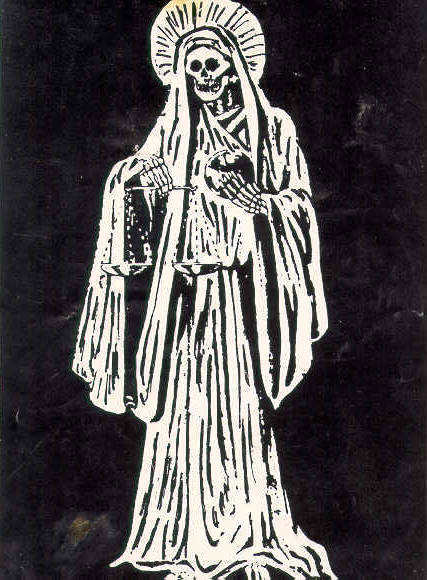
Worship of a saint called Death, a grinning skeleton in a habit and a halo, strikes me as eerie. Maybe it makes you feel the same. How, then, does it make you feel to think that you might yourself be a worshipper of death?
Santa Muerte
 
“El culto a la vida, si de verdad es profundo y total, es también culto a la muerte,” writes Paz. “Es inútil excluir a la muerte de nuestras representaciones, de nuestras palabras, de nuestras ideas, porque ella acabará por suprimirnos a todos y en primer término a los que viven ignorándola o fingiendo que la ignoran.” The cult of life, if it is truly deep and complete, is also the cult of death. It’s useless to exclude death from our representations, our words, our ideas, because she will eventually remove us all, and first of all those who lived ignoring or pretending to ignore her.
When we live in denial of our own temporality, we are feeding an insatiable void. We our pouring our breath down the hollow ribcage of a cold, dry, loveless thing. Worshipping life – physical existence – for the sake of its own pleasure turns us into worshippers of Santa Muerte, even if the altar we have built to her is in front of our computers or in our hearts instead of in Tepito.
 
When I strolled through the streets of La Roma or stood on the apartment roof to watch the morning sun spread over Mexico City, I took it all in with greedy eyes. I tried to extract every last drop of beauty from the world around me and stuff it into my soul. But I was never satisfied. The streets blurred together in my memory; the sunrise was always too short. My appetite for life devoured every living thing it its pathway, including my joy.
 
The curious thing about life is that it will never be sweet until you hold it loosely and love it less than you love the One who made it beautiful.
 
Sunrise from the roof - Psalm 19
 

Wednesday, July 31, 2013

A New Light

After reading my last blog post, a friend messaged me on Facebook.

"I was wondering: I've been doing a lot of thinking recently about Old Testament Messianic prophecies. In the section of Isaiah 42 you quote, God is speaking to the Servant, whom we now know to be Christ. How does that fit in with applying the passage to us and saying that we should open blind eyes, bring out prisoners, etc.? Is it because Christ perfectly did all of those things, and we are called to be like Him?

It doesn't seem to me that the passage can be applied directly to us because of the part that says, "I will give you as a covenant for the people." I don't believe that can apply to us at all. However, I do believe that the passage as a whole puts forth a lifestyle that we should strive for. Currently, with the limited thought I've put into the matter, it seems like the link between the passage and us is Christ--He fulfilled this passage, and we strive to follow in His example as well as fallen humans can.

What are your thoughts?"


This is what I said back:

Thank you so much for your though provoking question. I've been reading through Isaiah and finding a lot of encouraging passages, but not paying as much attention to the context as I should. I didn't realize this until I read your message. I re-read through Isaiah 42 (as well as John MacArthur's commentary on it) and the passage is talking about the Messiah. Before, I had thoughtlessly assumed it was speaking of the nation of Israel, since most of the book of Isaiah is. I believe the promises to Israel apply to Christians because we are grafted into the promise through Christ (Romans 9 & 11) and are now God's nation (1 Peter 2:9-10). Isaiah 42 isn't talking about Israel, though, it's talking about Jesus. I misapplied Scripture in my post without realizing it.

I do believe that being saved means confessing Christ as Lord (Romans 10:9-10), and it also means that we are called to imitate Him. God has called us to conform us to the image of His Son (Romans 8:29). So our purpose still applies, but not directly through the Scripture passage I used.

I'm going to go correct that on my blog. I am so thankful for you pointing out my misinterpretation. Scripture is the Word of God, and the last thing I want to do is distort it in any way!! You've also challenged me to start reading the Old Testament with more thought, care, and research.

     In a way, I'm thankful I misused the Isaiah 42 passage. That sounds terrible, doesn't it? But I am thankful, because I hate making mistakes. I hate being wrong. It's humbling for me to be confronted on an error, and I desperately need humility. Day in and day out, I find pride keeping me from serving God as I should because I'm more focused on my image, my agenda. Even the smallest chance to learn humility is such a blessing. I'm thankful for a friend (who I honestly don't know well at all) who is brave enough and loves Scripture enough to point me towards truth. I'm thankful for the example to me, because that's the sort of friend I want to be. I'm thankful for the challenge to study Scripture more carefully. 

     Oh, and above all, I'm thankful that Isaiah 42 is talking about the Messiah. Because the Messiah is Jesus Christ, my Savior, my Lord. I'm one of the prisoners He rescued from the dungeon. I'm the darkness His pure light shone to. As I study through Isaiah more carefully, there are treasure troves of verse I never noticed before, pointing towards Him. My purpose still stands: to shine, to speak the Good News. But the light I shine needs to be all His because His light is the brightest, and the words I speak need to be all His because only His name brings salvation.

Friday, June 28, 2013

Full


      I've been to a lot of places since I last wrote, places like stress and exhaustion, and stillness and warmth. And in a more literal sense, I went to Oral Roberts University for the NCFCA national championship. I arrived at nationals feeling wind-swept and desolate. A sense of finality hung around the car door slamming and the hotel doors opening and the elevator trip up to our room. I arrived empty, but I left full.


Mollie<3
Hannah's hotel ballet

    What I love about my speech and debate friends is the warmth, the acceptance. If I say something that comes out wrong, there's no uncomfortable stares or awkward silence-it's painted over with a laugh and becomes an inside joke. Everybody hugs everybody. There's no pressure to conform-poets and baseball players and classical musicians and rappers and computer geeks genuinely appreciate each other's different interests and abilities. 


     Conversations are interesting, about personality types or the truth about Abraham Lincoln or the effects of music on behavior. It's really refreshing after being daily deluged with dozens of canned exchanges about weather, sports, celebrities. And conversations are deep, probing the flaws in humanism and the truth of creationism and personal struggles. Questions like "What has God been teaching you?" and "Why do you not watch TV?" are refreshing after the halfhearted "How are you?", asked by someone who doesn't really seem to care how you're doing. NCFCA people care.


     Of course, there's plenty of hilarity, too. Like Larry the Cucumber becoming a vigilante in Switzerland, and Ben's unforgettable Christian pickup lines. Oh, and this:


         Nationals brought competition up a level, but it also brought the relationships up. Maybe it was the "common enemy" factor-Region IV was finally competing against other regions instead of itself. But more than that, we got to spend time together outside of our suits. Monday night after checking into the hotel, we went out to dinner at this burger restaurant called Mooyah's (according to Ethan, that's the sound the cows make when they die, 'cause that's not demented at all). A group of us decided to walk back to the hotel, but ended up playing in a ditch instead. It was a ditch running in front of a private school called Victory, so there was a regal stone bridge with shimmering golden letters crying "VICTORY" arched over this pathetic trickle of mud. We laughed for a long time about that one. Anyways, after the clumsier half of us got our pants soaked, we decided it would be better to swim in a real pool. We ran to Wal-Mart to buy swimsuits, reflecting our excellent, well-cultured sense of homeschool fashion. Really, it was just because Wal-Mart was on the other side of the ditch.

   The next day, intense outdoor games of ultimate Frisbee and capture the flag turned us white kids into giant tomatoes. Swimming and theological discussions were our respite. During the tournament, there was much coffee consumed and much cafeteria pizza eaten, because almost everything else in the cafeteria was quite cardboard-esque. The tension of competition offered lots of opportunities to trust God, and lots of chances to encourage and be encouraged. At the end, some sported radiant trophies and other a flimsy certificate or two. I learned from both kinds. At the after-party, trophies and the lack thereof were drowned out by the stomping and the clapping of the Virginia reel. A handful of us stayed until past four in the morning, discussing suicide, Biblical counseling, and the balance of grace and truth. And making goat noises. And building introvert caves under tables. And watching Doctor Who, or rather, watching Greg and Grace watch and recite each word of a Doctor Who season premier.

    Some of my best memories have been forged at Oral Roberts University, but they are carried in the hearts of dozens of dear people I wish I could see more often. It's times like these that I am indelibly thankful for texting and for social networking. I know I won't be able to keep up every friendship, but I hope that someday we'll bump into each other on a university campus or city sidewalk, and then it will all be the same. I'll never forget you.

My Region IV family<3


"I thank my God in all my remembrance of you, always offering prayer with joy in my every prayer for you all, in view or you participation in the Gospel from the first day until now. For I am confident of this very thing, that He who began a good work in you will perfect it until the day of Christ Jesus. FOr it is only right for me to feel this way about you all, because I have you in my heart...since you are all partakers of grace with me. For God is my witness, how I long for you all with the affection of Christ Jesus. And this I pray, that your love may abound still more and more in real knowledge and discernment, so that you may approve the things that are excellent in order to be sincere and blameless until the day of Christ; having been filled with the fruit of righteousness which comes through Jesus Christ, to the glory and praise of God."~Philippians 1:3-11~